Charles "CJ" Ponge Successfully Defends Dissertation on PFAS Removal Using Zeolites
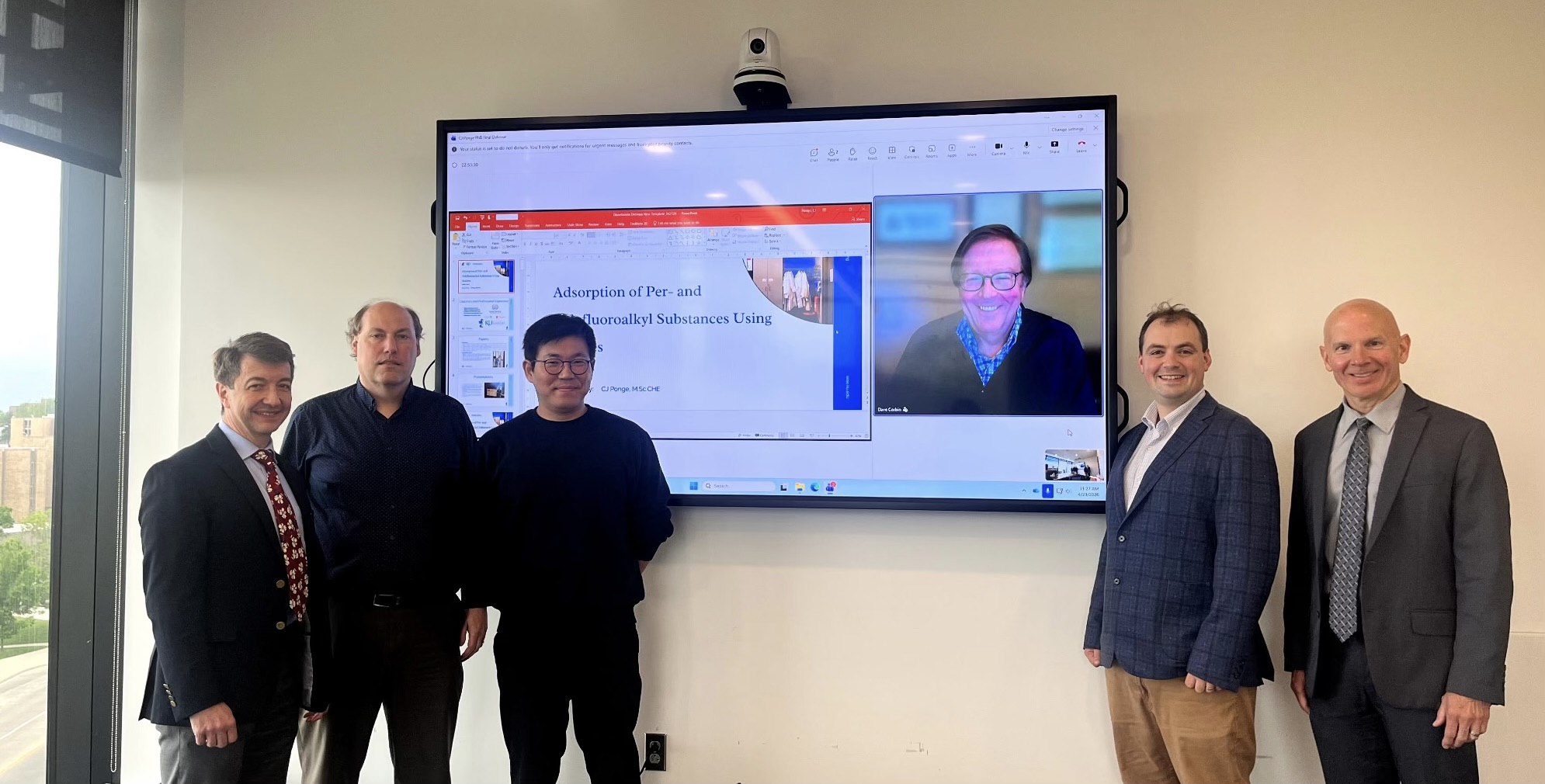
Lawrence, Kansas — April 23, 2026 — Charles "CJ" Ponge successfully defended his doctoral dissertation, Adsorption of Per‑ and Polyfluoroalkyl Substances Using Zeolites, marking a significant academic milestone and contributing important new insight to the global effort to remediate PFAS contamination in water systems.
Per‑ and polyfluoroalkyl substances (PFAS), commonly known as “forever chemicals,” are a large and diverse class of heavily fluorinated organic compounds recognized for their exceptional chemical stability and environmental persistence. With estimates suggesting there may be millions of distinct PFAS molecules, many still unidentified, these compounds present major challenges for environmental monitoring, regulation, and treatment. Their tendency to accumulate in water sources and biological systems has raised widespread concern due to associated environmental and human health risks.
CJ’s research addresses limitations of current PFAS remediation technologies, which primarily rely on sorbent materials such as activated carbon and ion‑exchange resins. While effective, these materials often require off‑site regeneration or disposal, creating cost, logistical, and sustainability challenges for long‑term deployment.
The dissertation explores the use of zeolites as alternative sorbent materials for PFAS removal. Zeolites are crystalline, microporous aluminosilicates with highly tunable pore sizes and chemical properties. Their structural diversity allows for selective interactions with a wide range of PFAS molecules, making them promising candidates for targeted adsorption.
Conducted under the mentorship of Dr. Mark B. Shiflett and in collaboration with the Wonderful Institute for Sustainable Engineering, the research demonstrates that ion‑exchanged zeolites can significantly enhance PFAS adsorption capacity and selectivity. By modifying the cations within the zeolite framework, the surface chemistry can be tuned to strengthen electrostatic and hydrophobic interactions, improving overall performance across different PFAS classes.
A key advantage highlighted in this work is the potential for in situ regeneration of zeolite sorbents. Unlike conventional materials that often require removal and replacement, zeolites may be regenerated on location through controlled thermal or chemical processes. This capability could reduce costs, minimize secondary waste generation, and improve the sustainability of PFAS treatment systems.
By linking zeolite structure, ion‑exchange chemistry, and adsorption behavior, CJ’s dissertation advances the fundamental understanding needed to design next‑generation PFAS remediation technologies that are effective, selective, and deployable at scale.
CJ’s successful defense reflects the combined efforts of dedicated mentorship and interdisciplinary collaboration, and it underscores the role of innovative materials science in addressing complex environmental challenges.
Wonderful Institute for Sustainable Engineering
The Wonderful Institute for Sustainable Engineering (WISE) at the University of Kansas is a multidisciplinary research institute focused on advancing global sustainability through engineering, science, and education. WISE brings together faculty, students, and industry partners to develop innovative solutions to real-world challenges related to energy, water, food, and climate. The institute emphasizes both research and education, aiming to equip students and researchers with the knowledge and skills needed to design sustainable technologies and processes. Through collaboration, hands-on programs, and applied research, WISE works to promote environmental, economic, and societal benefits while helping build a more sustainable future.
Thu, 04/23/2026
author
Media Contacts
Wonderful Institute for Sustainable Engineering
